Deep foundations
The foundation design considers load transfer, pile geometry and settlement criteria. Before discussing piling, gather the foundation layout, structural loading information and available borehole records.

When near-surface soils are unsuitable for the proposed loads, piles can carry forces to deeper strata. Selection depends on the geotechnical investigation and structural requirements.
Explore the relationship between foundation systems, excavation support and the conditions below the surface. These technical illustrations explain common methods; suitability and availability for a ROCKMAX project must be discussed individually.
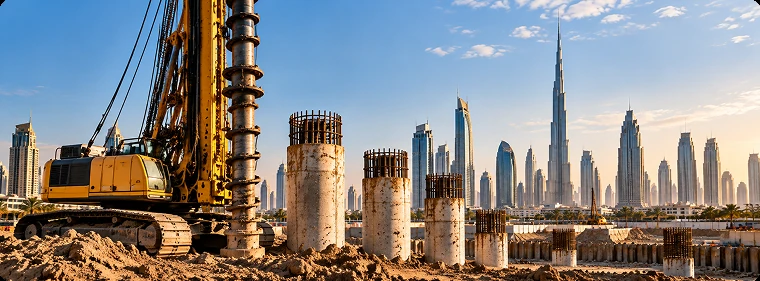
The foundation design considers load transfer, pile geometry and settlement criteria. Before discussing piling, gather the foundation layout, structural loading information and available borehole records.
A foundation system is chosen for the specific building, ground conditions and design requirements, not simply the size of the rig.
Soil and groundwater information informs design.
The structure determines the required support.
Adjacent properties and excavation geometry influence retaining needs.
Available working area and restrictions affect planning.
A pile can mobilise resistance along its sides and at its toe. Engineers assess the relative contribution using ground investigation data and design criteria.
Foundation performance involves both load capacity and movement under service conditions. The designer assesses expected settlement and compatibility with the supported structure.
Pile geometry, materials and required verification depend on approved specifications; these guide notes do not replace engineering advice.